

For decades, we have measured intelligence by scale. Larger models. More data. Faster computation. These improvements have produced remarkable results, and they raise a deeper question that scale alone cannot answer.
What is the underlying architecture that makes a system genuinely intelligent, rather than merely capable?
I have been sitting with this question for the past two years, approaching it from an unusual angle: not from inside an AI lab, but from the intersection of commercial technology deployment, physiological research, and careful attention to my own nervous system. What I keep finding is the same pattern appearing across very different domains, in neuroscience, in artificial intelligence, in the scientific method itself.
Intelligence may not be a thing. It may be a process.
Intelligence as a continuous feedback loop
Walking through a forest, your brain is not passively recording what you see. It is constantly predicting what should happen next. Where the path continues. Whether the ground is stable. Whether the sound in the bushes is wind or something else. Every moment, reality either confirms or challenges those predictions. When expectations match, models are reinforced. When they do not, understanding changes.
Artificial intelligence works in surprisingly similar ways. Modern AI systems learn by adjusting internal representations when predictions differ from observed outcomes. Science follows the same pattern: build a theory, make predictions, compare them with experiments, revise when evidence disagrees.
Across these very different domains, the same loop appears.
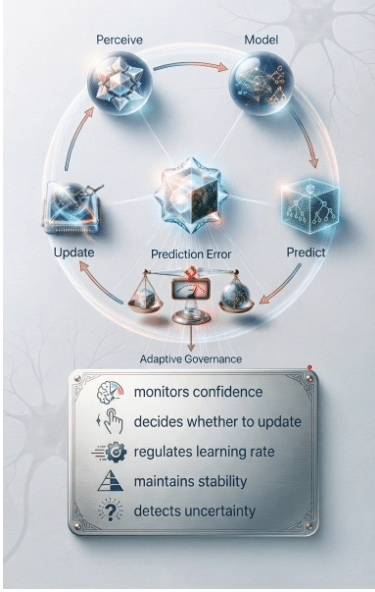
Perceive. Model. Predict. Compare. Learn. Repeat.
Perhaps this process is what intelligence actually is.
An architecture for intelligence
If that is true, intelligence can be understood as several interacting components.
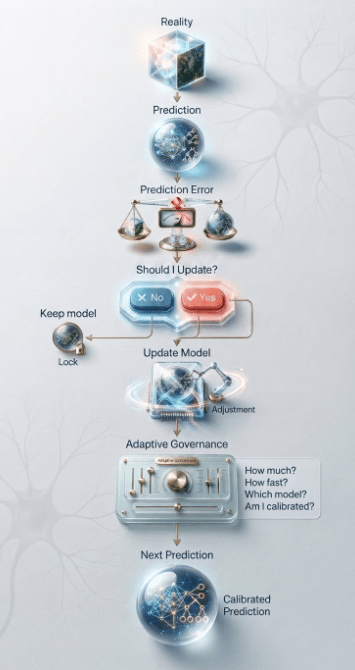
A system builds internal models of itself and its environment. It uses those models to predict what should happen next. It compares those predictions with reality, measures the mismatch, and decides whether its models should change. Then the cycle begins again.
The quality of intelligence depends less on never being wrong and more on how well this feedback loop operates.
Ideas related to predictive processing, world models, and active inference have been developed in neuroscience and AI over several decades. My intention here is not to replace those perspectives, but to propose an architectural extension: that intelligence also depends on mechanisms that govern when, how, and at what rate internal models should adapt.
Not every signal deserves an update
This last step deserves more attention than it usually receives.
An intelligent system should not update its internal models every time new information arrives. Imagine revising your understanding of physics because of one unusual observation. Or redefining your own abilities because of one critical comment. That would not be intelligence. It would be instability.
Before updating, a system needs a mechanism that asks:
Is this information reliable? Does it outweigh previous evidence?
Which internal model does it affect? How much should that model change? Or should I wait for more evidence?
The challenge is not simply deciding whether to update. It is deciding which model should update, by how much, and over what timescale.
Learning is not simply absorbing information. It is deciding what deserves to change your understanding.
Perhaps intelligence is not maximizing learning.
Perhaps it is learning at the right rate.
The goal is not to minimize prediction error as quickly as possible. It is to maintain models that remain well-calibrated over time.
Multiple models, different update speeds
An intelligent system probably does not maintain just one internal model. It maintains many simultaneously.
A model of the external world. A model of itself. A model of other people. A model of its goals. These should not all update at the same speed.
These models do not exist independently. Predictions are meaningful only in relation to what the system is trying to achieve. A changing objective changes which predictions matter and which updates become relevant.
My model of today’s weather can change within minutes. Scientific theories change only after years of accumulated evidence. My model of my own capabilities should change gradually, based on accumulated experience, not because of a single difficult moment.
Intelligence may depend not only on updating models, but on knowing how quickly each model should adapt. Too little updating creates rigidity. Too much creates instability. Genuine intelligence seems to require both, held in tension.
The missing layer: Meta-regulation
There is something I have been observing in myself for the past two years that I did not have a name for until recently.
When my nervous system is at peace, I notice patterns I completely miss when I am stressed. Not because the information is different. The same conversation, the same data, the same problem. But what I can see in it changes completely depending on the internal state I bring to it.
I noticed this most sharply after a bike accident I had recently in Berlin. Earlier that day I had spent hours at a technology fair, moving from booth to booth and processing a constant stream of information. My thinking was fast, but surprisingly shallow.
In the ambulance afterward, injured and exhausted, the paramedic began telling me about the difficult days he had been having. I found myself listening with a depth of attention that had been absent for most of the day.
The information itself was not different. The condition in which I received it had changed.
That distinction matters more than it sounds.
We spend enormous effort improving what AI systems know. More data, more parameters, more computational power. But performance depends not only on what a system knows. It depends on the condition of the system itself.
When the nervous system is under acute threat, attention often narrows toward immediate concerns, making it harder to integrate information across longer time horizons. The underlying knowledge may be unchanged, but the system cannot access it effectively because the conditions for thinking have changed.
Humans have always known this implicitly. We sleep. We move. We seek conversation. We breathe deliberately when the stakes are high. These are not luxuries or distractions from thinking. They are the mechanisms through which we restore the conditions that allow thinking to work properly.
I call this meta-regulation: the capacity of an intelligent system to monitor whether its current internal state is helping or hindering its ability to perceive, model, update, and decide. More broadly, it can be understood as a form of adaptive governance over the learning process. What I am describing is less about internal states and more about governance: the mechanisms that determine which models update, when, and by how much. Not just what the system knows, but whether the system is in a condition to use what it knows well.
This remains a hypothesis. But as AI systems become more autonomous and operate in higher-stakes environments, I believe this will become one of the most important architectural questions we face.
Beyond bigger models
Much of today’s AI progress still comes from scaling. That approach has produced results that would have seemed impossible a decade ago. But some of the most interesting recent findings, in interpretability research, in neuroscience, in the study of how biological and artificial systems actually process information, suggest that the next frontier may not be more scale.
It may be better architecture.
Specifically: It means improving the interaction between perception, internal models, prediction, selective updating, and the meta-regulatory layer that governs when and how updating should happen.
A system that knows when to update is more capable than a system that simply knows more.
An open question
The more I explore this, moving between neuroscience and AI research and my own observations, the more I find the same pattern. Intelligence is not static. It is a continuous negotiation between expectation and reality, governed by mechanisms that most AI systems do not yet have.
Perhaps the future of intelligence is not systems that accumulate ever more knowledge, but systems that become increasingly skillful at deciding what to learn, what to ignore, and when to change their minds.
Perhaps intelligence is ultimately measured not by how much a system knows, but by how skillfully it governs the evolution of its internal models.