
Most conversations about AI focus on jobs.
Will it replace me? Will my skills still matter?
Important questions. But they are not the most important ones.
A quieter shift is already underway, and it touches something more personal than employment.
Our intelligence.
You are training AI how you think
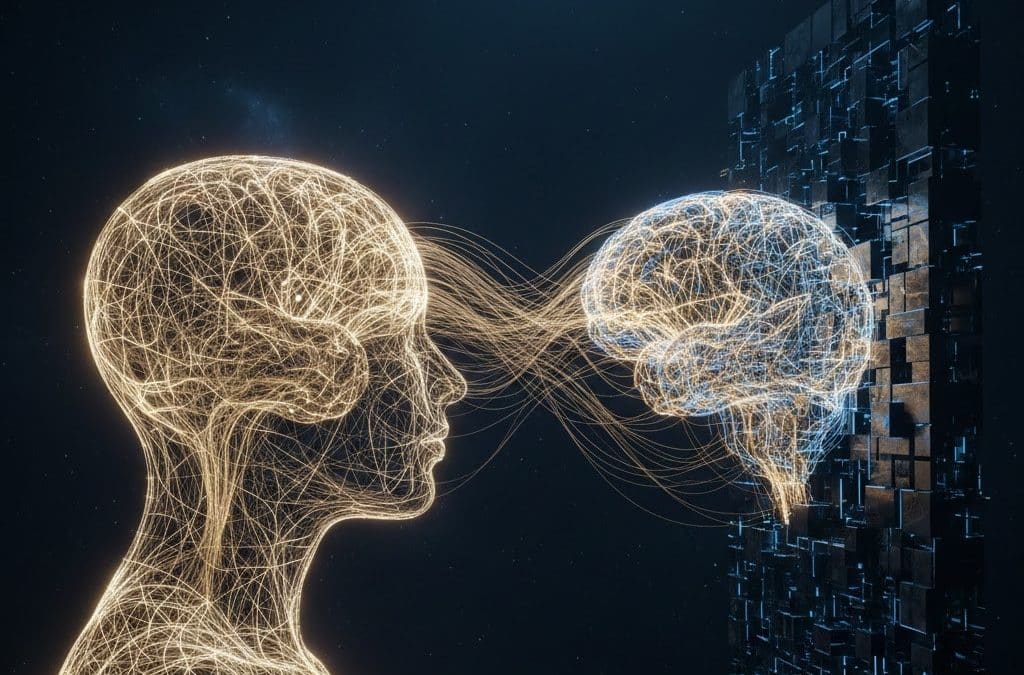
If you have spent time working with AI tools like ChatGPT, Claude, or Gemini, you have been doing more than using software.
You have been teaching them how you think.
Not what you post publicly, but how you reason, explore ideas, and make decisions. The inner logic of your thinking.
This is not shallow data.
It is not metadata.
It is a living record of your cognition.
Social media captured what we performed. AI captures how we think. The process, the nuance, the inner logic.
And right now, most of us are giving this away without fully realizing its value.
We have seen this pattern before
We have seen this story play out.
With social networks, we built audiences on platforms we did not own. Leaving meant losing everything.
With cloud platforms, our files are technically ours, but practically locked in. Switching is possible, but costly.
AI follows the same pattern, but what is being controlled this time is not your social graph or your files.
It is your cognition.
Every meaningful conversation you have with an AI system lives on someone else’s servers. They decide what is remembered, what is learned, what persists, and what disappears.
Switch tools, and you start from zero. All the context is gone.This is not just about convenience.
It is about control.
Why the job debate misses the point
Yes, AI will change work. Some jobs will disappear. Others will emerge.
But focusing only on jobs misses the deeper leverage point.
The real question is not who does the work. It is who owns the intelligence that guides it.
We are moving toward an economy where AI agents research, plan, execute, and transact. For that to work, they need memory, context, and intelligence.
Whoever owns the memory layer controls the relationship.
Right now, that ownership sits almost entirely with platforms.
What actually becomes scarce
In a world where machine intelligence is abundant, what becomes scarce is not information or output.
It is judgment. Perspective. Synthesis. Context.
The ability to know what matters.
The ability to connect ideas across domains.
The ability to bring lived experience into new situations.
Here is the key insight.
Your AI memory is not just data about you.
It is a working model of your intelligence.
That is not something to fear.
It is something to take responsibility for.
The case for sovereignty and decentralization
Imagine a different setup.
Your AI memory belongs to you, technically and practically. It moves with you across tools. New systems do not start from zero. Your context, preferences, and way of thinking follow you.
This is where decentralized AI models matter.
Not as ideology, but as infrastructure.
Decentralized approaches separate intelligence from platforms. Memory is not locked into a single company. Models can interoperate. Users retain control over their data and the agents built on top of it.
Centralized platforms cannot easily offer this. Shared memory weakens lock in. Portability weakens control.
Decentralization exists precisely to solve that problem.
The ecosystem is still emerging. The solutions are incomplete. But the direction matters.
What this means for you, right now
You do not need to abandon the tools you are already using.
But you can start asking better questions.
Where does my AI memory live?
Can I export it?
What happens if I switch tools?
Who benefits from the intelligence I am creating?
Your cognitive data is valuable. Your relationship with AI is becoming long term. Ownership will define who benefits from this transition.
The architecture is not set yet. That is the window.
You can accept the default lock in and become a passenger.
Or you can stay attentive, ask harder questions, and support systems that move toward sovereignty, portability, and user control.
Because there is more to the future than just simply watching it unfold.
It is shaped by the infrastructure we normalize.
And the most important question is no longer whether AI will shape our lives.
It already is.
Ultimately, the real question is who owns the intelligence we are creating together.