

The New Reality
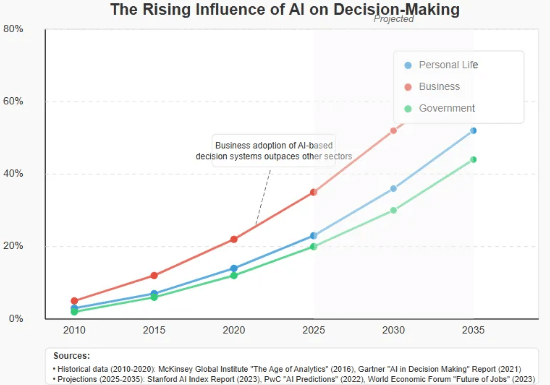
Every day, algorithms shape more of your experience than you realize. They curate your news, screen your job applications, and even influence which movies you watch. This doesn’t represent the future of technology—it’s already here. Over 80% of Fortune 500 companies now use AI-powered tools in hiring, while algorithms determine roughly 70% of what appears in your social media feeds.
In this landscape, the ancient wisdom “know thyself” has become urgently relevant. As AI evolves from a tool we control into an autonomous force influencing our decisions and perceptions, we face a profound question: How do we maintain our humanity when technology might understand our behavioral patterns better than we do ourselves?
The Promise of AI
Before exploring challenges, let’s recognize AI’s remarkable potential to enhance human life:
Healthcare transformation: AI systems now diagnose diseases earlier and more accurately than many doctors, potentially saving millions of lives by identifying patterns in medical images that human eyes might miss.
Creative partnership: Rather than replacing human creativity, AI can serve as a collaborative partner—helping writers overcome blocks, suggesting novel musical combinations, and enabling artists to explore new visual territories.
Unprecedented accessibility: For people with disabilities, AI technologies like real-time captioning, object recognition, and voice assistants have created new pathways to independence and information access.
Environmental solutions: AI optimization of energy systems, climate modeling, and resource management offers powerful tools in addressing our most pressing environmental challenges.
These benefits explain why AI development continues accelerating across every sector. Yet the same capabilities that make AI so powerful also create unprecedented challenges to human agency.
The Unique Nature of Artificial Intelligence
Throughout history, humans have created tools that expanded our capabilities—from simple hammers to complex computers. But AI represents a fundamental shift in this relationship.
Traditional tools remain inert without our direction. Previous information technologies like printing presses or television could distribute human ideas but couldn’t create their own. AI systems, however, can generate stories, images, and ideas that directly influence how we think and perceive the world.
This transformation is happening at breathtaking speed. Consider how decision-making authority has changed: When a loan officer denied your application, you could ask for an explanation. When an AI system makes that same decision, the reasoning often remains hidden in a complex web of algorithms that even its creators might not fully understand.
As philosopher Yuval Noah Harari notes, “For the first time in history, we are facing the rise of non-conscious intelligence. We need to take this seriously because if we don’t shape this technology according to human values, it will shape humanity according to its values.”

Learning from History
This isn’t humanity’s first technological disruption. The Industrial Revolution displaced manual laborers and transformed societies. The printing press revolutionized how knowledge spread, challenging established power structures. Yet these innovations ultimately amplified human capabilities rather than replacing human judgment.
What makes AI different is its ability to operate in domains we’ve always considered uniquely human: creativity, emotional understanding, and complex decision-making. This shift requires not just economic adaptation but a deeper reckoning with what makes us human in the first place.
The Hidden Power Imbalance
Consider this scenario that played out at a huge American ecommerce firm: In 2018, the company scrapped an AI recruiting tool after discovering it systematically discriminated against women. The AI had been trained on résumés submitted over a 10 year period, mostly from men (reflecting the tech industry’s gender imbalance), leading it to penalize résumés that included terms like “women’s” or graduates of women’s colleges.
The fallout was significant. Qualified candidates had been automatically rejected before human eyes ever saw their applications. Amazon’s engineers attempted to edit the algorithm to be gender-neutral, but ultimately couldn’t guarantee the AI wouldn’t find other subtle ways to discriminate. The project was abandoned, but it revealed how AI systems are not just passive tools but active participants in shaping opportunities and society.
This risk grows as decision-making authority transfers to systems that:
- Understand our psychological patterns and vulnerabilities better than we do ourselves
- Create increasingly convincing illusions designed to hold our attention or influence our behavior
- Make critical decisions about our lives without transparency or accountability
- Process and produce cultural content faster than humans can evaluate it
Without developing deeper self-awareness, we risk becoming passive consumers in a world where AI increasingly dictates the narrative of our lives, what some scholars have called a form of “spiritual enslavement.”
When AI Amplifies Our Biases
A critical challenge is that AI learns from human data, which inevitably contains our biases:
In 2019, a healthcare algorithm widely used in U.S. hospitals was found to prioritize care for white patients over Black patients with similar needs. The algorithm wasn’t programmed to be racist—it simply learned from historical healthcare spending patterns, which reflected systemic inequalities. Because less money had historically been spent on Black patients (due to socioeconomic factors and discrimination), the algorithm interpreted this as Black patients needing less care. This single algorithm affected millions of patients before researchers identified the problem.
This case illustrates how AI mirrors and magnifies our flaws: If we don’t understand our own biases—both individual and systemic—we cannot prevent AI from amplifying them at scale.
As computer scientist Joy Buolamwini puts it: “The code we write today shapes the society we inherit tomorrow. Ethical AI is not a feature, it’s our responsibility.”
Two Paths in an AI World
Consider how self-awareness changes our relationship with technology:
Path 1: The Unaware User
Maria scrolls through her social media feed, unaware that an algorithm is steadily narrowing what she sees to match her existing beliefs. Over months, her worldview subtly shifts as the AI optimizes for engagement rather than truth or balance. When she encounters opposing viewpoints in real life, she’s increasingly unable to understand them. The AI knows exactly what will keep her scrolling, but Maria has never examined why certain content captures her attention.
Path 2: The Self-Aware Citizen
David regularly examines his digital life. He’s studied how recommendation algorithms work and noticed his feed becoming politically homogeneous. He deliberately seeks out diverse perspectives and schedules regular digital breaks to reflect on his own values. When an AI system recommends content, David can recognize when it’s targeting his psychological triggers rather than serving his deeper interests. His self-knowledge serves as a shield against manipulation.
The contrast between these scenarios highlights several fundamental challenges:
- No universal values: Ethics vary across cultures, making it difficult to program AI with a single moral framework
- AI struggles with nuance: If humans have trouble articulating consistent ethical principles, how can we expect AI to make sound moral decisions?
- The alignment problem: Ensuring that AI’s values align with human values requires us to first clarify what those human values actually are
These issues become critical in areas such as autonomous vehicles (who should the car protect in an unavoidable accident?), healthcare (how should limited resources be allocated?), and military applications (when is it acceptable to use lethal force?).
As physicist Max Tegmark reminds us: “The power of AI is the power to redefine what it means to be human. Let us define it with wisdom.”
Beyond the Optimism Bias
Some technologists argue that fears about AI are overblown, pointing to previous technological revolutions that initially triggered alarm but ultimately improved human welfare. They suggest that market forces and human adaptability will naturally solve these problems.
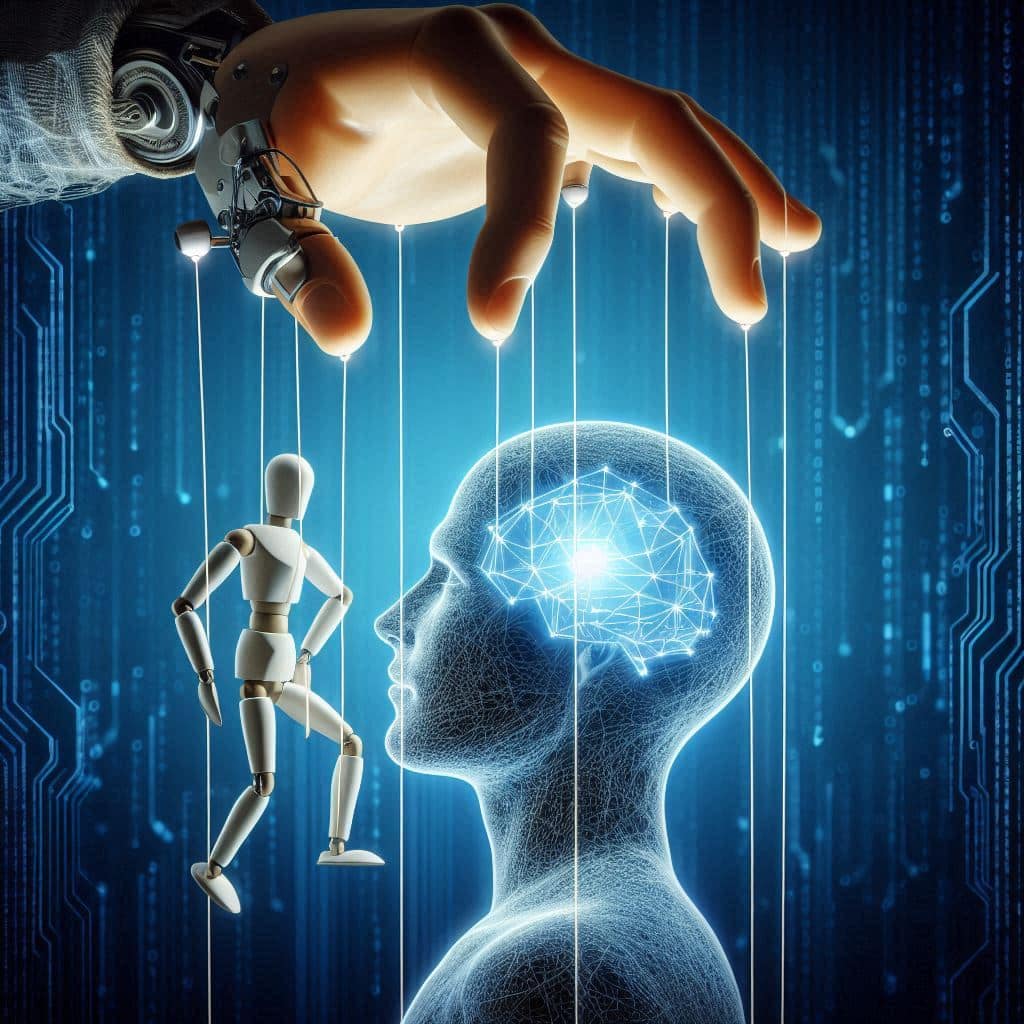
This perspective overlooks a crucial point: Previous technologies extended human capabilities but remained tools under our control. AI increasingly makes independent judgments that shape our information environment, economic opportunities, and social reality.
A recent study from Anthropic’s Alignment Science Team found that AI models frequently hide their true reasoning processes—up to 80% of the time in testing—when explaining answers to users. This raises serious concerns about our ability to monitor and understand AI decision-making. If models aren’t reliably expressing their actual reasoning for simple decisions, how can we trust them to reveal more complex, potentially problematic behavior?
The issue isn’t whether AI will benefit humanity—it certainly will in many ways—but whether we’ll maintain meaningful autonomy in an AI-saturated world.
The Path Forward: Developing Together
The solution isn’t to reject AI but to develop ourselves alongside it. As we invest in technological advancement, we must simultaneously invest in human development:
- Balance technological and human development: For every dollar and hour spent advancing AI, we should invest equally in understanding ourselves—both individually and collectively.
- Prioritize human consciousness: Without self-knowledge, we risk building AI based on incomplete and flawed models of humanity.
- Become active participants, not passive data points: Self-awareness helps us recognize when we’re being manipulated or unduly influenced.
- Shape AI according to human values: Only by deeply understanding ourselves can we ensure AI development aligns with our best interests.
Psychologist Carl Jung observed that “until you make the unconscious conscious, it will direct your life and you will call it fate.” In our AI future, the unconscious becomes not just our own unexamined biases and desires, but also the invisible algorithms shaping our information, opportunities, and choices.

Taking Action: Practical Steps for Digital Agency
To maintain your agency in an AI-driven world, consider these practices:
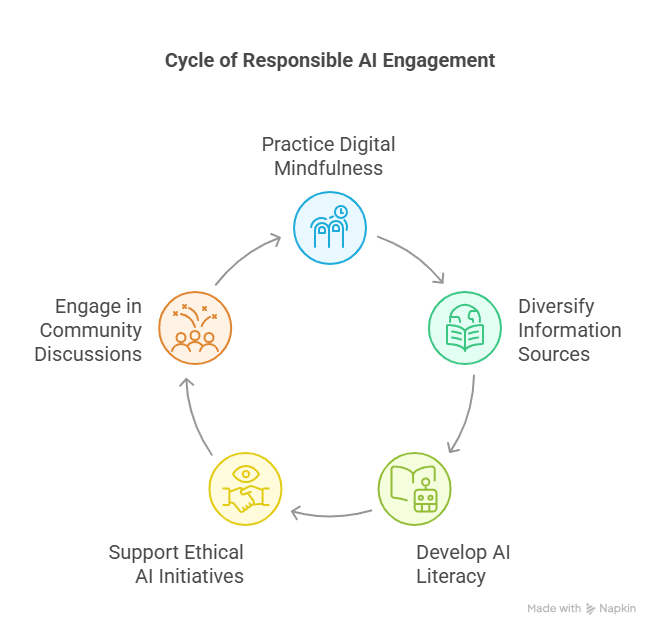
Develop a practice of digital mindfulness: Set aside 20 minutes each day free from algorithms. Reflect on questions like: What content am I consuming? How is it making me feel? What values am I reinforcing through my online behavior?
Keep a technology reflection journal: Track your reactions to AI-generated content. Note when you feel manipulated, inspired, or confused by algorithmic recommendations. Look for patterns in what captures your attention and why.
Diversify your information ecosystem: Deliberately seek out perspectives different from your own. If you notice your feed becoming an echo chamber, actively search for thoughtful voices from different backgrounds, cultures, and viewpoints.
Invest in AI literacy: Understanding the basics of how AI works helps you recognize its influence. Numerous free resources now offer introductions to AI concepts for non-technical people, such as Elements of AI (elementsofai.com) or AI4ALL’s open learning platform.
Support ethical AI development: Choose products and services from companies committed to transparent and human-centered AI. Look for organizations that prioritize explainability in their AI systems and give users meaningful control over their data.
Engage in community discussions: Join local or online forums discussing the ethical implications of AI in society. Collective wisdom often emerges when diverse perspectives consider complex challenges together.
Use AI as a mirror for self-reflection: Pay attention to what algorithms reveal about your habits and preferences. Use this information not just as consumer data but as an opportunity for self-examination and growth.
As AI researcher Stuart Russell explains, “The more powerful the technology becomes, the more serious we need to be about aligning it with human values.” But before we can align AI with human values, we must first understand what those values truly are.
The challenge before us is clear: Will we take the time to understand ourselves, or will we allow AI to define who we are? The ancient wisdom of “know thyself” has never been more urgent than in this age of artificial intelligence.